While
it remains critical for interior designs to meet practical demands, the
limitless options offered today in stone and tile collections also allow these
spaces to express personality. From chic and sophisticated to cool and casual,
today’s interior spaces are representing the characteristics and mood of their
occupants — and a palette of stone and tile is a key component to obtaining
each unique design.
Using stone and tile is no longer just about material selection. While choosing
the appropriate stone for a countertop or deciding between porcelain or glass
tile for a kitchen backsplash can affect the tone of a room, there are many
other options to consider nowadays. Textures are playing a large role in
product development today. In addition to polished and honed surfaces, there
are so many other finishes offered. Tiles are now being manufactured with
surfaces that replicate the feel of textiles as well as natural materials such
as wood and stone. A smooth glossy porcelain tile or iridescent glass mosaic
can bring a feeling of modern elegance, while rough-cut pieces of limestone or
slate can conjure a warm rustic environment.
With
the availability of all these options in stone and tile, architects and
designers are really stretching their imaginations and thinking outside the
box. They are presenting their clients with new ideas and unique applications
that are visually stimulating and stir emotions. In particular, homeowners are
taking more of an interest in the selection process — even expressing their own
ideas on products and finishes to architects and designers.
Soft mountain contemporary
This was the case for a couple rooted in Austin, TX, who recently devoted much
of their time and energy to building their dream vacation home in the scenic
town of Telluride, CO. Originally a mining community at the turn of the
century, the mountain town of Telluride, which sits among 14,000-foot peaks at
the base of the Telluride ski area, has become known for its luxurious resorts
and features a National Historic Landmark District with Victorian-era
architecture. As a result, the homeowners had to be mindful of the building’s
historic surroundings while at the same time developing their own signature
look for their home’s interior with a rich palette of stone and tile.
“A
lot of small towns like Aspen and Telluride have a very western main street,”
explained homeowner Katrine Formby. “This building is in an historic district,
but it happens to not be an historic building. There are a lot of rules when
remodeling in an historic area. You can’t just put a glass box on the
outside.”
While the first level of the building is a commercial space that is not owned
by the Formbys, the couple does own the upper levels of the structure. Formby
explained that the lower level of the residential space was converted into a
one-bedroom condominium, and the two floors above that comprise a three-bedroom
penthouse.
“We were originally going to do a ‘light’ remodel, but we ended up almost
gutting the entire space,” said Formby. “The interior is ‘soft mountain
contemporary.’ The mountains are very majestic in Telluride. We wanted the
materials to take a backseat to the scenery.”
Throughout
both the condominium and penthouse, stone accent walls were built in various
spaces such as the living room, dining room and bedrooms. Additionally, the same
material was utilized for rustic fireplaces. “We are really pleased that when
people come in, they think that the stone was originally there,” said Formby.
“That’s the look that we wanted.”
The Formbys worked closely with Todd Hopgood of Hopgood Building Co. in
Telluride to choose just the right combination of stone for the walls and
fireplaces. “A lot of mock stone samples were
done — different stones, different patterns and different grouts — and then
more samples were done,” said Formby. “We wanted it to look old, and we wanted
it to look natural. Our builder, Todd Hopgood, came up with the magic
formula.”
Hopgood explained that a combination of stone was used to achieve the look that
his clients desired. “The majority of the stone was Kensington Stone from
Robinson Brick Co. in Denver,”
he said. “We blended that with a locally quarried stone called Telluride Gold
to get the color contrast. It was quarried just outside of Telluride by the
Telluride Stone Co. It is a pretty common material that is used to maintain
continuity — especially in the Mountain
Village, which is the
small village above Telluride.”
According
to the builder, the stone used for the interior walls and fireplaces in both
residential spaces is a thin veneer — ranging from 1 ¾ to
2 ¾ inches in thickness. “We chose thin veneer for structural reasons,” he
said. “It was an existing foundation, so we wanted to keep assemblies as
lightweight as possible. [Also], it saved on interior
space.”
The stone walls are grouted with a custom color mortar. The Formbys wanted the
stone pieces to have an aged appearance. “Originally, I was given some
[pictures] of old European homes to get me in the ballpark,” said Hopgood.
“Older techniques are just a little different than what we do now. We put a
light mortar wash over the face of the stone [to get the desired
effect.]”
For the fireplaces, the mortar joints are recessed — presenting a dry-stacked
look. “The mortar joints are recessed so that architecturally it stands out,”
said Hopgood.
In
addition to the stone wall, another point of interest in the condominium dining
room is the floor, which consists of a pattern formed by Walnut planking and
Sebastian flagstone from Aplin Masonry in Telluride. “My husband designed the
dining room floor and our architect refined it,” said Formby. “He knew he
wanted some Walnut wood in between the stone.”
Walnut
flooring was carried into the kitchen of the condominium and subtly accented by
a Jet Black granite countertop with a thickness of 3 cm — supplied by Cactus
Stone & Tile of Phoenix, AZ. “I started out wanting this fantastic granite
that was bright red and green,” said Formby. “I thought, ‘This is absolutely
gorgeous.’ Then I thought more about it and decided that it was too dominant
and we needed to tone it down. The more I worked on the spaces; I realized that
people that go to Colorado
want to rest. So, I wanted my eyes to rest, and the restfulness of the black
[granite] convinced me.”
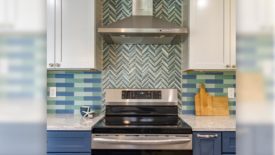
The 6- x 12-inch Lake Garda Driftwood Gloss glass tiles by Ann Sacks Tile &
Stone, which were selected for the kitchen backsplash by Dawne Stewart of
Signature Floors and More in Corsicana, TX, also create a soothing look. The
tiles were horizontally stacked. “I have gotten so many compliments on them,”
said Formby. “They have a beautiful natural clean color that is harmonious with
the stone.” The same palette was reproduced in the penthouse kitchen, although
12- x 12-inch glass tiles were used for the backsplash.
A
mix of stone and tile was also employed for one of two master baths in the
penthouse. The floor as well as the shower walls consists of 12- x 24-inch
Cappadocia White Linen tile from Ann Sacks. To bring contrast to the
light-colored floor tiles, Black River granite
— supplied by Cactus Stone & Tile — was chosen for the vanity
top.
A point of interest in the space is a two-sided fireplace that also is seen
from the master bedroom. The base of the fireplace as well as a portion of the
surround layer is formed with 9/16-inch Linen mosaic straight marble tile from
Ann Sacks. The top of the surround is comprised of 5/8- x 8-inch Linen marble
pencil liners and the top of the base is the same Black River granite employed
for the vanity top.
For a second master bath in the penthouse, the homeowners opted to have the
vanity top and the face of the tub surround fabricated from Juparano Persa
granite, which was also supplied by Cactus Stone & Tile. Lake Garda Hemp
gloss 12- x 12-inch glass
tiles were employed for the shower walls. The neutral shade of the tile is a
nice balance to the wild veining found in the granite. Additionally, 12- x
24-inch tiles in the color “Bark” from Ann Sacks’ Summit Line was chosen for
the floor. “We used larger pieces because they are more contemporary,” said
Formby.
Design and construction of the Telluride condominium and penthouse took
approximately two and a half years to complete. Installation of the stone walls
and fireplaces was finished in about seven weeks, according to the builder.
“Everything
had to be just right,” said Hopgood. “In the penthouse, there were a lot of
little details that did take some time. The mock-up process was the most
challenging. Once we got it, we got it.”
Hopgood said there were five stonemasons on the jobsite. “This was simply
because we had to go up several flights of stairs,” he said. “We had some guys
mixing and remixing mortar, some hauling stone up the stairs and some putting
the stone on the walls.”
According to Formby, she and her husband are very pleased with the final result
of the renovation. “Once we decided on the stone, there was no problem,” she
said. “It all went beautifully. One thing I was surprised at is that the
sunlight from the mountains gives a little green cast [on the stone]. When we
put the stone against our wall in our Austin
home it looked beige, and then when we put it on the wall in Colorado it looked a different color. We
really had to look at it in the light to make sure that it looked
right.”
While the Formbys spend a couple of weeks at their new vacation home — dubbed
“The Heart of Telluride” — in the winter to ski and also a couple of weeks
there in the summer, they rent the spaces out the other time during the year.
“We have been fantastically thrilled with the response,” she said.
Urban sophistication
In contrast to the warm rustic feel of the mountains, stone and tile were used
to bring a cool clean look to a residential high-rise in Miami, FL.
Not far from the luxury
oceanfront homes that line the beaches of Miami
is Brickell Avenue
— an up and coming hotspot for young professionals. And among the new
residential high-rises to open on the street is 500 Brickell, which utilizes a
palette of stone and tile to bring a trendy hip vibe to the building’s public
spaces.
“Brickell
Avenue is one of the main streets of downtown Miami,” explained designer
Michael Wolk of Wolk Design Associates of Miami, FL. “It’s an area where they
are hoping young professionals will live in these buildings. It’s a little
lower profile than the condos on the beaches that are people’s second and third
homes. It has a young urban look and feel.”
The 40-story high-rise is comprised of two towers, and its lobby features a
contemporary design, with Gold quartzite used for both the walls and floor. “We
wanted it to have a fresh cool urban feel,” said Wolk. “The quartzite worked in
with our palette. It’s such a varied stone. It goes from pink to orange to
brown. A lot of times we choose stone for its monotone characteristics. In this
case, it was just the opposite.”
For
the lobby walls, small slabs of quartzite form a random pattern. While some
pieces protrude others are recessed. “The idea of [the wall design] is that it
shows some strength like a building block,” said the designer. “The stone itself
had something to do with that [idea]. The pieces were random sizes and had
different thicknesses. We just took our cue from that by exaggerating
it.”
According to Wolk, quartzite is a challenging material to work with because it
is so varied. “Fabrication requires a lot of hand selecting and sorting,” he
said, adding that at the start of installation, he was on site often to
supervise. “Once we set up what was acceptable, we didn’t have to be there as
much.”
Among
the new residential high-rises to open on Brickell Avenue in Miami, FL, is 500
Brickell, featuring a trendy hip lobby that is a showcase of Gold quartzite
Designer: Wolk Design Associates, Miami, FL
An
open airy modern environment was also created in a lounge area of the
residential high-rise with a combination of materials. Hardwood floors are
paired with colorful tile mosaics that reflect a cheery and “fun” atmosphere.
Bands of bright shiny colorful Ribbon Mosaics form accent walls around the bar.
Additionally, glass mosaics from Vidrepur were used to create a focal point on
the ceiling. The iridescent tiles form the background of a cut-out where a
ceiling fan was placed. “We wanted something with a lot of sparkle and color to
it,” said Wolk, when explaining why the mosaics were selected for the design.
An
open airy modern environment was also created in a lounge area of the
residential high-rise with a combination of materials. Hardwood floors are
paired with colorful tile mosaics that reflect a cheery and “fun” atmosphere.
In
total, it took approximately three years to complete the design and
construction of 500 Brickell.
Custom contemporary
Positioned between the North and South forks of Long Island,
NY, is Shelter Island
— a secluded piece of land that spans about 8,000 acres, with a good portion
being protected wetlands nature preserve marshland. Nearly a third of the
island is owned by The Nature Conservancy, and the rest of the land makes for
peaceful surroundings for private residents. Recently, a home was constructed
on the shore overlooking Greenport Harbor, and Spanish tile was utilized to
create a unique focal point in the kitchen that captures the homeowner’s love
for the sea.
The
public restrooms of 500 Brickell feature a sleek modern design with
dark-colored stone and tile mosaics.
“Shelter
Island is a very charming place with a New England feel,” said David Patrick of
Chelsea Arts Tile + Stone in New York, NY, who served as the designer and
project coordinator. Patrick explained that he was approached by architect
Russell Piccione with a 19th-century map that was sourced from the local
historical society. “He had a client in Shelter Island,
and they wanted to use something from local history [in the design of their
home],” said Patrick.
According to Piccione, incorporating a tile map into the design of one of his
projects is something that he had longed to do. “The idea came from a trip that
I took many years ago to Portugal,” explained the architect. “I went to this
amazing monastery. These were very rich monasteries. They are magnificent
moments in the history of Portugal.”
The
focal point of a kitchen in a home on Shelter
Island, NY, is a
nautical map made from custom-made Spanish tile, which is a tribute to the
homeowner’s love for the sea. Architect: Russell Piccione, New York, NY; Tile
Supplier/Map Designer: Chelsea Arts Tile + Stone, New York, NY; Tile
Manufacturer: Ceramica Decorativa, Spain; Tile Painter/Printer: Tile Guild, Los
Angeles, CA; Tile Installer: Brian Italiano, Brooklyn, NY
Photo courtesy of Chelsea Arts Tile + Stone
Piccione
went on to explain that the monastery that he visited had every surface tiled
with depictions and plans of the gardens of all its properties. “It seemed like
a map room, but it was all done in tile,” he said. “It was so visually lasting.
It’s one of those things that you file away in your
memory.”
The homeowner is a world-class sailor, so the tile wall map was quite
appropriate for the kitchen design, said Piccione. “We found a 19th-century map
of Shelter Island,” explained the architect. “We used that for our land map,
but because my client is a very serious sailor, we took contemporary navigation
charts and used those for all the markings of the water. You can actually sail
by consulting the map.”
.com.
In
addition to the tile map, the clean contemporary look of the kitchen is
achieved with countertops fabricated from white marble that was quarried in
Greece along with limestone flooring.
Piccione
worked closely with Patrick to develop a custom-made ceramic tile map that
would cover one entire wall in the kitchen. “It started off as a grand but
straightforward request, and then we realized there was much more to it,” said
Patrick. “The client enjoys sailing, so he wanted certain points on it that
weren’t on the [historic] map. We had to enlarge the scope of the
map.”
According to Patrick, contemporary maps and satellite imagery were implemented
to expand upon the map. “They wanted it to be accurate,” he said. “Not that
they would literally sail from it, but they wanted to be able to look at it and
roughly plan a sail. We needed to include the lower coastline of Connecticut
and other areas that weren’t on the original map.
“I
used a consultant with a background in design as well as earth science,”
Patrick went on to explain. “It’s amazing that once you get into it, you can
see how much maps can be distorted and outdated. I like maps and 19th-century
history, so this whole challenge really appealed to me and became much more
than an order.”
Patrick explained that he drew the map digitally over the course of months and
then separated the 10- x 14-foot image into smaller panels that were more
manageable.
“We used a silk screen process,” said Patrick. “The original map was copper
plate engraving, and this is very close to that historical process. It was
roughly plotted out using silk screen and then certain things were enhanced and
others were wiped away to soften it and give an antique look. Altogether, this
map was the product of 15th- and 21st-century technology.”
“We
used [a 19th-century map] for our land map, but because my client is a very
serious sailor, we took contemporary navigation charts and used those for all
the markings of the water,” said architect Russell Piccione. “You can actually
sail by consulting the map.”
Photo courtesy of Chelsea Arts Tile + Stone
Piccione
was very pleased to see his vision come to fruition. “What David did was
extraordinary,” he said. “The [historical] map was incomplete. He was able to
fill in some missing parts. Shelter Island fits between the North Fork and
South Fork, and the map didn’t show all of that.”
Hand-molded red-body 6- x 6-inch tiles from Tile of Spain-branded manufacturer
Ceramica Decorativa were selected as the “canvas” for the map. “From the
beginning, I had no question what tile we were going to use,” said Patrick. “I
have used Decorativa tile for years. It has a modulated surface that has a
hand-molded look without being too rustic.”
According to Patrick, the architect desired the blue and white Portuguese-style
look of the tiles. “If we tried it in polychrome, it would have been a very
different map,” he said. “Blue and white made it more modern, in a way.” And to
further enhance the contemporary design of the kitchen, white marble from
Greece was chosen for the countertops and limestone was employed for the
floor.
For the printing, painting and firing, Patrick relied on the expertise of
artist Dennis Cafferty of Tile Guild in Los Angeles, who he has worked with in
the past. “He has worked with Decorativa tile for years,” said Patrick. “One
quality that he is able to achieve with that tile is an antique ‘fogginess.’”
Once
the tiles were fired, each one was marked for layout by the installer, Brian
Italiano of Brooklyn, NY. Prior to installation, the tiles were laid
out on the floor.
Photo courtesy of Chelsea Arts Tile + Stone
In
total, the project took about a year to complete. “A lot of it was stop and
go,” said Patrick. “Most of this was pre-production — drawing the map and
getting the position right. If we made the wrong move early on, everything
would have been off. This is remarkably accurate given all the
variables.”
Once the tiles were fired, each one was marked for layout by the installer,
Brian Italiano of Brooklyn,
NY. “The installer I have known
for years,” explained Patrick. “There were certain nuances to putting it up.
You want it in the right hands.”
Prior to installation, the tiles were laid out on the floor, according to
Patrick, who was on site during the installation. “I was very grateful to the
architect on every level,” he said. “You don’t always have this much input over
a special project like this.”
The nautical tile map was installed in the Shelter Island
home in September of 2008. “I met the homeowners when I was on site for the
installation,” said Patrick. “They couldn’t have been nicer. It was very
satisfying — this was a unique opportunity and I was proud to be involved.”
JenniferAdams Jennifer Adams is Editor of Contemporary Stone & Tile Design.
|
Did you enjoy this article? Click here to subscribe to the magazine.
Digital Edition
An interactive version of our print magazine allows you to easily read, share with friends, and click on web links to get further resources.